
भारतीय उष्णदेशीय मौसम विज्ञान संस्थान
Indian Institute of Tropical Meteorology
पृथ्वी विज्ञान मंत्रालय, भारत सरकार का एक स्वायत्त संस्थान
An Autonomous Institute of the Ministry of Earth Sciences, Govt. of India


Scientist Profile

Mr. Harikrishna Devisetty
Designation
: Scientist C
Phone
: +91-(0)20-25904764
Fax
: +91-(0)20-25865142
Email ID
: harikrishna[dot]d[at]tropmet[dot]res[dot]in
Radar and Satellite Meteorology
| Degree | University | Year | Stream |
|---|---|---|---|
| Ph.D | AcSIR, New Delhi / IITM, Pune | Pursuing | Physical sciences |
| M.Tech | JNTU Anantapuramu, Andhra Pradesh | 2022 | VLSI & Embedded systems (ECE) |
| B.Tech | JNTU Anantapuramu, Andhra Pradesh | 2014 | Electronics and Communication Engineering (ECE) |
| DIPLOMA | GMR Polytechnic Madanapalle, SBTET, Andhra Pradesh. | 2011 | Electronics and Communication Engineering (ECE) |
 Remote sensing of the atmosphere, clouds and precipitation (using Radars and in situ observations).
Integrating advanced radar technologies and networked instruments for comprehensive precipitation studies over India.
Disdrometer Network over India.
| Award Name | Awarded By | Awarded For | Year |
|---|---|---|---|
| Best Overall Pavilion Award | Hon’ble Governor of Haryana | MoES Exhibition Expo at the India International Science Festival (IISF) Science, Technology, Defence, and Space Exhibition | 6-9 December 2025 |
| Year | Designation | Institute |
|---|---|---|
| July 2026-Present | Scientist C | Indian Institute of Tropical Meteorology, Pune |
| 2023(Jun)-June 2026 | Scientist-B | Indian Institute of Tropical Meteorology, Pune. |
| 2018(Oct)-2023(Jun) | Technical Assistant | CSIR-National Aerospace Laboratories, Bengaluru. |
| 2016(Aug)-2018(Oct) | Project Scientist B | Indian Institute of Tropical Meteorology, Pune. |
| 2015(Aug)-2016(Aug) | Junior Engineer (Instrumentation/Electronics) | Indian Institute of Tropical Meteorology, Pune. |
| 2015(Apr)-2015(Jul) | Technical Assistant | National Atmospheric Research Laboratories (ISRO), Gadanki, Tirupati. |
Research Highlight
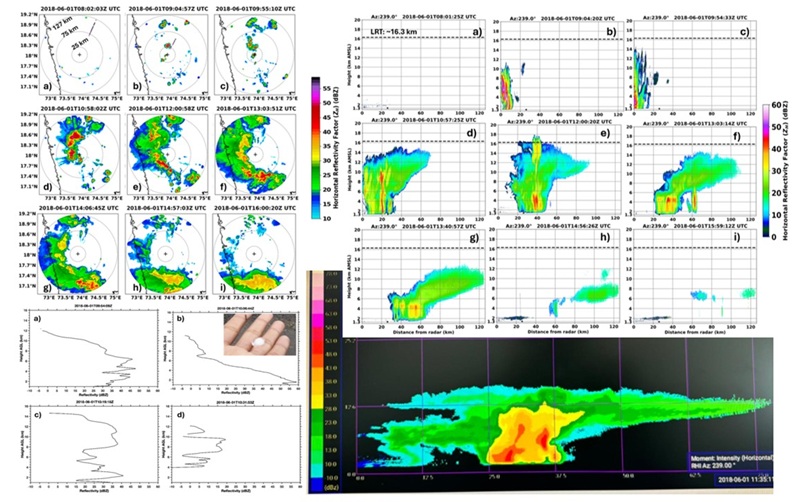
Study on Overshooting Convective Storms (OCS) in the Western Ghats region– multi-sensor approach
Overshooting Convective Storms (OCSs) are deep convective storms penetrating the tropopause level, typically 16-20 km in the tropical region. The study combines X-band dual-polarization Doppler weather radar, lightning observations, Disdrometer measurements, satellite data, ERA5 reanalysis, and radiosonde observations to characterize one of the region's most intense convective events.