
भारतीय उष्णदेशीय मौसम विज्ञान संस्थान
Indian Institute of Tropical Meteorology
पृथ्वी विज्ञान मंत्रालय, भारत सरकार का एक स्वायत्त संस्थान
An Autonomous Institute of the Ministry of Earth Sciences, Govt. of India


Scientist Profile

Dr. Devendraa Siingh
Designation
: Scientist F
Phone
: +91-(0)20-25904287
Fax
: +91-(0)20-25865142
Email ID
: devendraasiingh[at]tropmet[dot]res[dot]in
| Degree | University | Year | Stream |
|---|---|---|---|
| Ph.D. | Banaras Hindu University | 1999 | Physics (Space Plasma Physics) |
| M.Sc. | Banaras Hindu University | 1994 | Physics |
| B.Sc. | Banaras Hindu University | 1992 | Physics |
 ELF/VLF emission in ionosphere/ magneto sphere
Sferic and whistlers
Ion and aerosol Physics
Global Electric circuit
Atmospheric Electricity
Space weather
Sprites, Jets, Elves and anomalous electric field/TLEs
Impact of Urbanization on lightning and thunderstorm
Influence of aerosol on lightning and thunderstorm
| Award Name | Awarded By | Awarded For | Year |
|---|---|---|---|
| Visiting scientist | Center for Sun-Climate Research, Danish National Space Center, Copenhagen, Denmark | Work on “Measurements on Ion –induced nucleation and Cosmic rays” | February - March, 2008 |
| P. Krishna Rao Award | Indian Meteorological Society, New Delhi | Application and Satellite data and Remote Sensing in Meteorology | 2018 |
| Research Adviser and Editorial Board Member | Nan Academy of Science, Government of Singapore. | - | 2018 |
| Best paper award | Indian Institute of Tropical Meteorology, Pune | For the paper on Measurements of ions and air-earth current at Maitri, Antarctica | 2007 |
| Better Opportunity for Young Scientist in Chosen Area of Science and Technology (BOYSCAST) Editor | Department of Science & Technology, Government of India, New Delhi Scientific World Journal (Atmospheric Sciences) | Research work Institute of Environmental Physics, University of Tartu, Tartu, Estonia. | 2005-2006 |
| Adjunct professor and teacher of Physics | Department of Physics, University of Pune | - | 2003 |
| Senior Research Fellowship | Council of Scientific & Industrial Research (CSIR), Government of India, New Delhi | Research work at Department of Physics, Banaras Hindu University, Varanasi | 1998 |
| Junior Research Fellowship | Council of Scientific & Industrial Research (CSIR), Government of India, New Delhi | Research work at Department of Physics, Banaras Hindu University, Varanasi | 1996 |
| UGC University Fellowship | UGC | Research work at Department of Physics, Banaras Hindu University, Varanasi | 1995 |
| Editor | Earth Science Research, Canadian Center of Science Education | - | - |
| Fellow | Society of Earth Scientists | - | - |
| Editor | Scientific World Journal (Atmospheric Sciences) | - | - |
| Year | Designation | Institute |
|---|---|---|
| 2022-Present | Scientist F | Indian Institute of Tropical Meteorology, Pune |
| 2016-2021 | Scientist E | Indian Institute of Tropical Meteorology, Pune |
| 2012-2015 | Scientist D | Indian Institute of Tropical Meteorology, Pune |
| 2007-2012 | Scientist C | Indian Institute of Tropical Meteorology, Pune |
| 2006-2007 | BOYSCAST Fellow, DST | Institute of Environmental Physics, University of Tartu, Estonia |
| 2005-2007 | Scientist B | Indian Institute of Tropical Meteorology, Pune |
| 2004-2005 | IITM Group leader scientist | Indian station Maitri (Antarctica) |
| 2004-2005 | Junior Scientific Officer | Indian Institute of Tropical Meteorology, Pune |
| 1999-2004 | Senior Scientific Assistant | Indian Institute of Tropical Meteorology, Pune |
| 1998-1999 | Senior Research Fellow (CSIR) | Banaras Hindu University |
| 1996-1998 | Junior Research Fellow (DST) | Banaras Hindu University |
| 1995-1996 | UGC Research Fellow | Banaras Hindu University |
Research Highlight
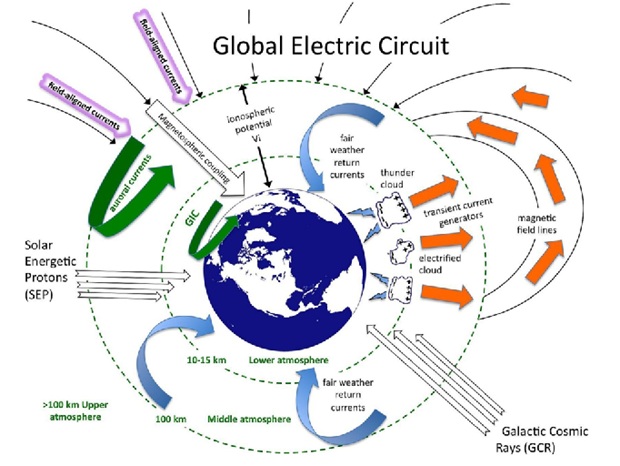
The DC and AC global electric circuits and climate
The paper reviews recent advances in the DC and AC Global Electric Circuits (GEC) and their links with climate variability, showing that thunderstorms and electrified shower clouds are major generators of the DC circuit, while global lightning maintains the AC circuit through Schumann resonances. It highlights that atmospheric electricity is controlled by interacting meteorological conditions, aerosols, clouds, temperature, rainfall, water vapour, ENSO, solar activity and cosmic rays, with aerosols capable of substantially modifying atmospheric conductivity and columnar resistance. The review also demonstrates the potential of Schumann resonance and atmospheric electric-field observations as tools for monitoring global lightning and climate variability, while emphasizing that regional and land–ocean differences remain insufficiently understood. The authors recommend coordinated, long-term simultaneous measurements of lightning, atmospheric electricity and meteorological variables, particularly over oceans, together with improved modelling, to quantify the global contributions of thunderstorms, electrified clouds, transient luminous events and other sources and to better understand GEC–climate interactions under global warming.