Seminars / Lectures

New Report by IITM Scientists
1. Assessment of Tropical cyclone tracking algorithms for the north Indian Ocean

Read Full Report
2. Comprehensive Assessment of Tropical Cyclones over the Indian Ocean

Read Full Report
Bharat Forecast System
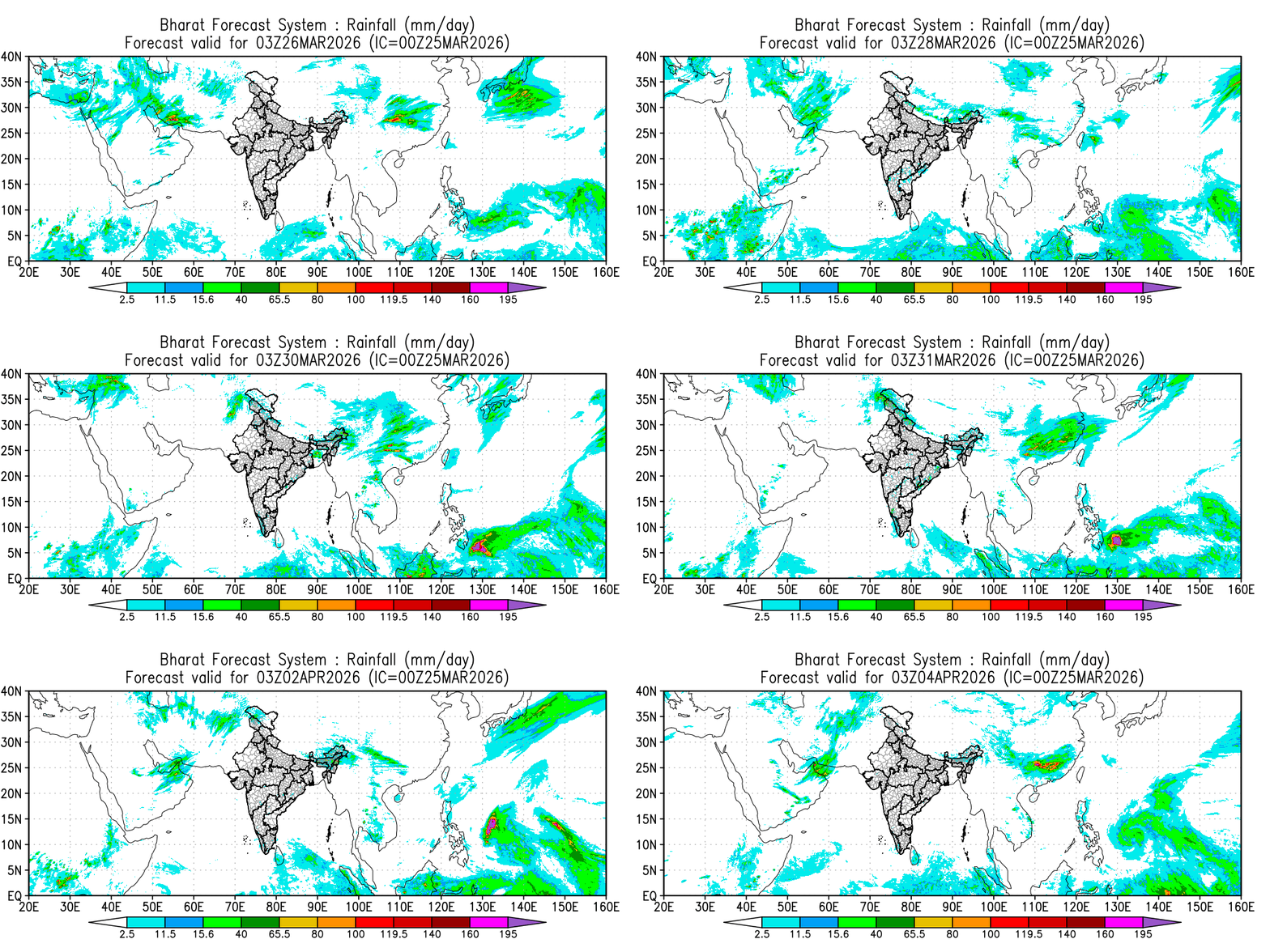
REAL TIME FORECAST
High resolution air quality forecast at 400 meter over Delhi

Air quality forecast at 10 km over India

IITM Publication Highlights

Influence of tropical cyclone Biparjoy in exacerbating heatwaves and aerosol forcing over the Indian subcontinent
Tropical Cyclone Biparjoy (June 2023) exacerbated June heatwaves (HWs) across India by inducing subsidence and enhancing long-range dust transport, causing a temperature rise. The cyclone acted as a catalyst, reinforcing a high-pressure ridge and driving intense aerosol loading (up to) through strong westerlies, which contributed to atmospheric warming and strengthened the compound TC-HW-Aerosol event. The findings emphasize the importance of monitoring how cyclones interact with regional atmospheric pressure patterns, as they can accelerate atmospheric heating rather than simply reducing it.
Banerjee S., Padmakumari B., Rajeevan M., Atmospheric Research, 334: 108790, April 2026, DOI:10.1016/j.atmosres.2026.108790, 1-14
Read More

Cloud microphysical processes of lightning-producing convective clouds over Northeast India: Insights from in-situ and TRMM observations
This study reports on the cloud microphysical processes of lightning-producing clouds that developed over Northeast India in September 2009. It uses unique in-situ measurements of cloud properties made by an instrumented aircraft, along with a near-simultaneous TRMM satellite overpass (TRMM-PR, TRMM-LIS) that profiled the storms and detected lightning strikes. The findings of this study enhance our understanding of the evolution of DSD shapes in drizzle-forming convective clouds. Furthermore, the new parameterizations of the autoconversion rate in lightning-producing clouds could be valuable for improving numerical weather prediction models. Furthermore, this study indicates the need for region-specific or environment-specific parameterizations of the autoconversion rate. This study also emphasizes the importance of investigating ice nuclei properties, which can significantly influence storm characteristics as a whole.
Konwar M., Choudhury B.A., Longkumer I., Axisa D., Atmospheric Research, 333: 108704, April 2026, DOI:10.1016/j.atmosres.2025.108704, 1-15
Read More
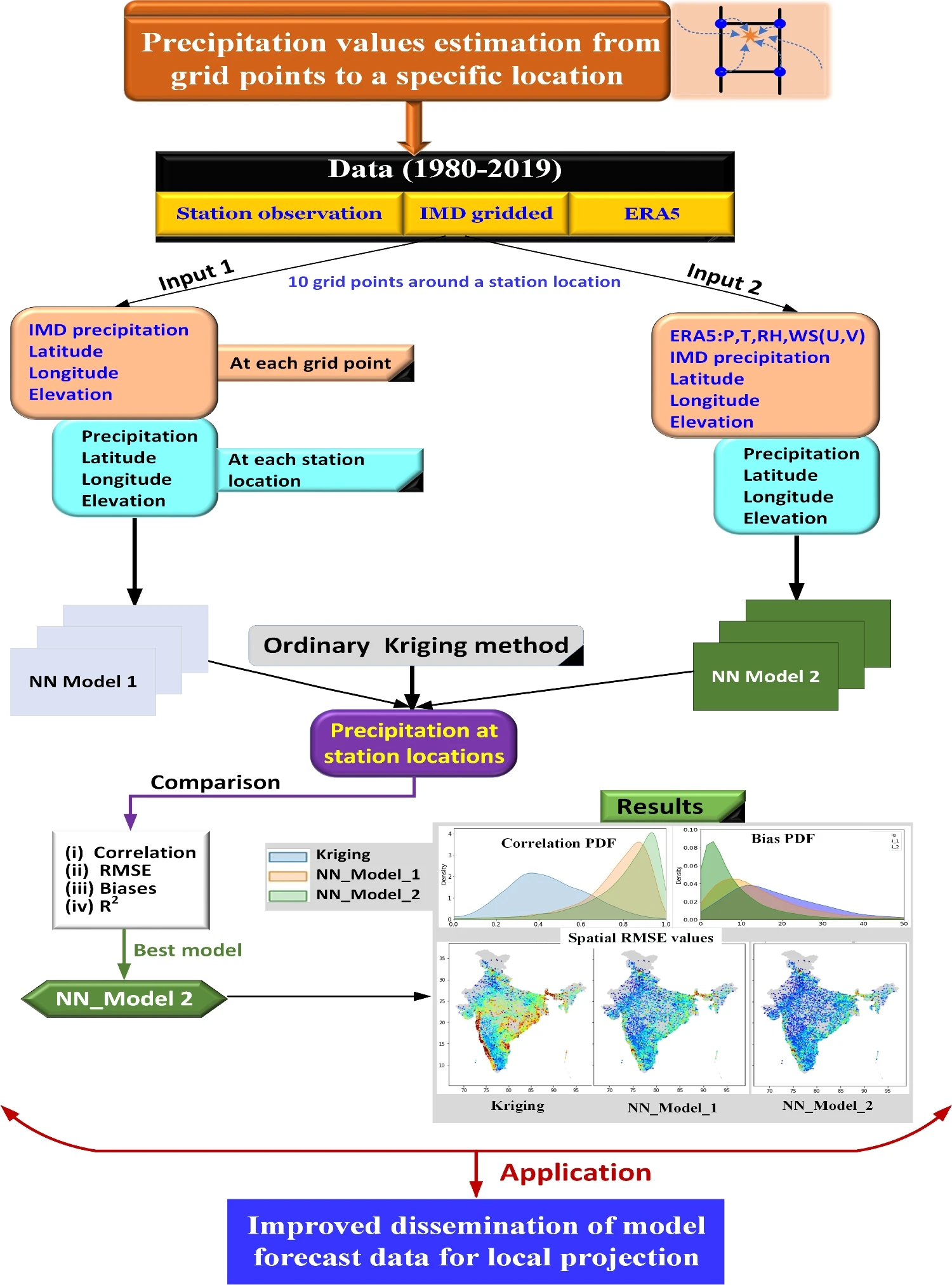
Estimation of location-specific precipitation using Deep Neural Networks
This study presents a paradigm shift by using Deep Neural Networks (DNNs) demonstrating superiority over the traditional methods like Kriging for station-specific precipitation approximation. A thorough analysis of identifying the best nearest neighbour approximation and computation time is carried out to ascertain the computational and methodological supremacy. To achieve this, we introduced an operational approach by developing DNN models as alternatives to traditional interpolation methods such as Kriging. These models outperform Kriging across various evaluation metrics (correlation coefficient, root mean square error, bias, and skill score) on a five-year validation set for any given location. This compelling evidence demonstrates the transformative power of deep learning for spatial prediction, offering a robust and precise alternative for hyperlocal precipitation estimation.
Kumar Bipin, Yadav B.K., Mukhopadhyay S., Rohan R., Singh B.B., Chattopadhyay R., Chilukoti N., Sahai A.K., Theoretical and Applied Climatology, 157: 223, March 2026, DOI:10.1007/s00704-026-06185-z, 1-17
Read More

Arctic Sea Ice Meltdown Enhances the South Asian Summer Monsoon Rainfall
This study highlights the important relationship between Arctic sea ice variability and the ISMR, providing new insights into their teleconnections and associated mechanisms. Our analysis reveals that Arctic sea ice extent during JJ shows the strongest inverse correlation with monsoon rainfall in the later phases (AS), indicating that Arctic sea ice variability exerts an increasing influence on monsoon dynamics as the season progresses. Furthermore, the study shows that the decline in Arctic sea ice is associated with a westward shift in the second phase (AS) of the monsoon rainfall pattern, thereby enhancing precipitation over the northwestern and eastern parts of India. These findings indicate that the long-term decline in Arctic sea ice can drive systematic changes in the South Asian monsoon through upper-level dynamical pathways.
Chaudhari H.S., Saha Subodh K., Pokhrel S., Rai A., Ocean-Land-Atmosphere Research, 5: 0129, January 2026, DOI:10.34133/olar.0129, 1-14
Read MoreNew Publications

Comparative Evaluation of Short-Range Extreme Rainfall Forecast by Two High-Resolution Global Models
Goswami T., Kolusu S. R., Chowdhuri S., Ganai M., Deshpande M., Atmosphere, 17: 304, March 2026, DOI:10.3390/atmos17030304

On emerging circulation patterns driving the continued rise in heavy rains across western India
Mukherjee S.K., Ayantika D.C., Krishnan R., Dey D., Environmental Research: Climate, 5: 025006, March 2026, DOI:10.1088/2752-5295/ae4a41, 1-22

Interplay between anthropogenic emissions, monsoon circulation, and trace metal deposition in rainwater over a rapidly urbanizing region of southwestern India
Gawhane R.D., Nikam M., Karri D., Waghmare V., Mukherjee Subrata, Budhavant K., Gandhi N., Padmakumari B., Urban Climate, 66: 102851, March 2026, DOI:10.1016/j.uclim.2026.102851, 1-14

Arctic amplification and modal variability of the Hadley cell on interannual timescales, Environmental Research: Climate
Chaudhary A., Chattopadhyay R., Kalshetti M., Joseph S., 5: 015024, February 2026, DOI:10.1088/2752-5295/ae3f49, 1-21
IITM Events

Atmospheric Thermodynamic Workshop (NT-ATW)
(16-18 March 2026)
The workshop organized by IITM in collaboration with Max Planck Institute at IITM Pune aimed to explore the potential of thermodynamic metrics for enhancing Earth system models in India, focusing on land-atmosphere interactions, climate change in the Himalayas, extreme rainfall and drying trends, and the Indian monsoon in a changing climate.
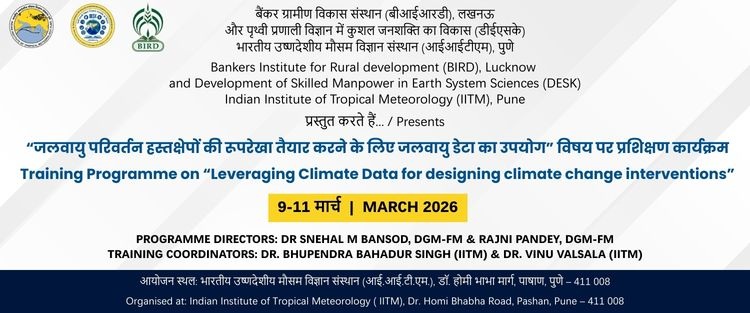
Training Programme on “Leveraging Climate Data for Designing Climate Change Interventions”
(09-11 March 2026)
IITM successfully hosted the Training Programme in collaboration with BIRD, Lucknow. The programme engaged around 35 participants from various government and non-government institutions, fostering learning and collaboration on climate interventions.
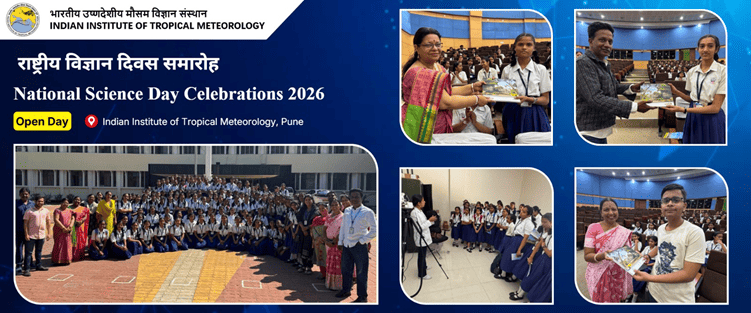
National Science Day
(28 February 2026)
IITM hosted an Open Day on 27 February 2026, as part of National Science Day celebrations. The event aimed to provide students and visitors with interactive experiences related on weather, climate, and oceans, including Q&A sessions with scientists and visits to research labs. IITM also participated in the Science Expo at the GMRT, Narayangaon during 28 Feb to 01 March 2026.
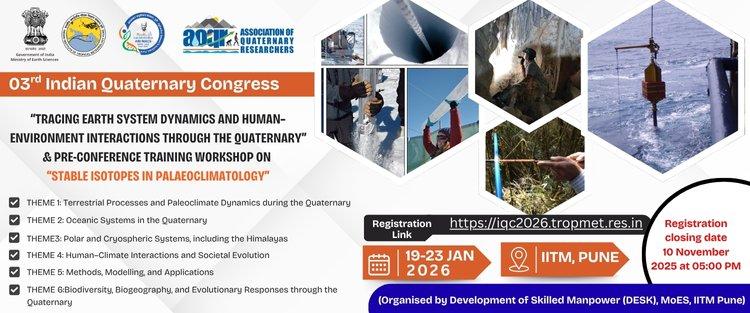
3rd Indian Quaternary Congress (IQC) WMO Scientific Conference on Weather Modification
(19-23 January 2026)
IQC-2026 featured a two-day Pre-conference training workshop (19-20 January 2026) on the theme “Tracing Earth System Dynamics and Human–Environment Interactions through the Quaternary”, followed by a three-day Pre-conference training workshop on “Stable Isotopes in Palaeoclimatology” (21-23 January 2026). The IQC-2026 aimed to foster discussions on the challenges and advances in Quaternary climate research. The third edition, IQC-2026 jointly organized by IITM Pune and the Agharkar Research Institute, in collaboration with the Association of Quaternary Researchers (AOQR), with co-sponsorship from INCOIS, the National Centre for Polar and Ocean Research, Thermo Fisher Scientific, and Elementar.